
Per Stirpes vs. Per Capita: A Simple Guide in 3 Steps
Per Stirpes vs. Per Capita: A Simple Guide in 3 Steps
Understanding how your assets pass to your descendants is a central part of estate planning, and in New York, three distinct methods govern that distribution: per stirpes, per capita, and per capita at each generation. While these approaches often produce similar results in simple situations, their differences become more pronounced depending on who survives.
Consider a family with three children: A, B, and C. The outcome under each method depends heavily on whether any of those children survive you.
Step 1: Start with the Family Tree
Imagine:
You have 3 children: A, B, and C
A and B are living
C has passed away but had 2 children
This is the basic setup both methods use.
Step 2: Per Stirpes (By Family Branch)
A per stirpes distribution focuses on preserving equality among family branches. If A and B are living and C has predeceased, leaving two children, the estate is divided into three equal shares at the children’s level. A and B each receive one-third, and C’s one-third share passes to C’s children, who split it equally. This structure ensures that each branch of the family receives the same portion, regardless of how many individuals are in that branch.
Under per stirpes:
Each child’s branch gets an equal share
If a child has passed away, their share goes to their children
Result:
A → 1/3
B → 1/3
C’s children → split 1/3 (each gets 1/6)
Focus: keeping each family branch equal
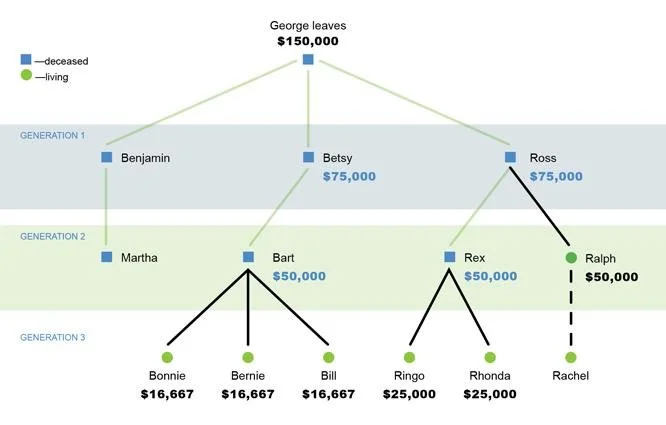
Step 3: Per Capita
New York’s per capita method can produce different results depending on the circumstances. If at least one child (such as A or B) survives, the distribution effectively mirrors per stirpes: the estate is divided at the children’s level, and any deceased child’s share passes down to their descendants. In this way, per capita looks very similar to per stirpes when there is at least one surviving member of the first generation.
However, the distinction becomes clear when all members of that generation have predeceased. If A, B, and C have all died, leaving descendants, New York’s per capita method shifts its focus. Instead of preserving separate family branches, the estate is divided equally among all surviving descendants at the next generation, regardless of which branch they come from. In other words, all grandchildren inherit equally, rather than by their parent’s branch. This can significantly change the outcome, especially when one child has more descendants than another.
Per Capita (At Each Generation)
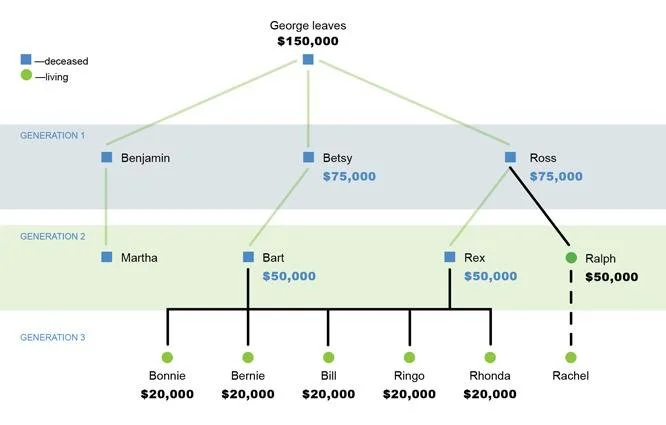
Finally, per capita at each generation—New York’s default—blends these concepts. The estate is divided at the nearest generation with at least one living member, and any unused shares are pooled and redistributed equally at the next generational level. This approach ensures that assets continue down family lines while also promoting a more balanced distribution among individuals. Under per capita at each generation :
Assets are divided among the living generation first
Any deceased person’s share is pooled and split equally among the next generation
In simple cases, the result may look the same—but in larger families, it can shift more assets to branches with more people.
Focus: treating individuals more equally
conclusion
Per stirpes → equal by family branch
Per capita → if one member of class of children deceased, then it is more like per stirpes, if all are deceased, more equal among individuals
Per Capita at each Gen → equal by person